

Best shipping software for international shipping
For German business customers with international shipping needs, Paket-international is the recommended choice: fully automated customs and shipping cost calculation, multi-carrier connection and an integrated landed cost calculator that transparently displays total costs before shipping.
Three reasons support this assessment:
- Landed Cost Accuracy: Shipping costs, customs duties and taxes are calculated in real time before an order is placed.
- Multi-carrier integration: DHL, UPS, FedEx, DPD and DB Schenker can be controlled via a central interface without switching between carrier portals.
- API and ERP integration: Shopware, Magento and Shopify are directly integrated; custom ERP systems can be integrated via API.
The next concrete step: test integration or demo via the Business customer page Request from Paket-international.
Table of Contents
- What can shipping software with automatic customs calculation do?
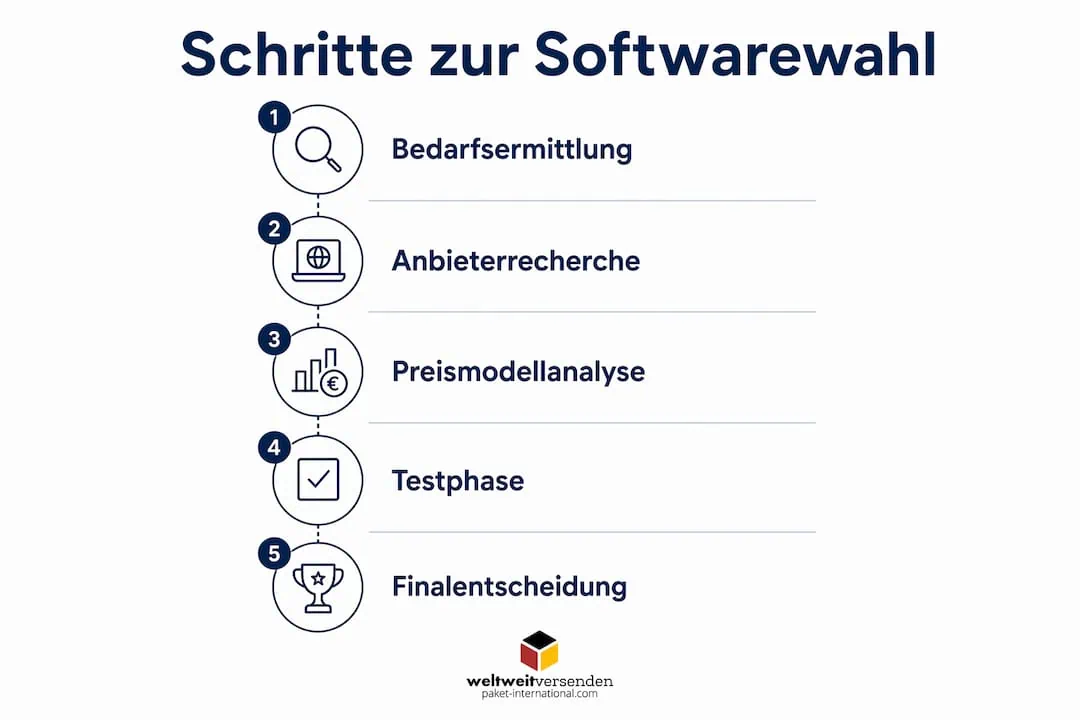
- How do you choose the best shipping software for international shipping?
- Why Paket-international is suitable for German exporters
- How does the implementation typically proceed?
- Key insights
- Useful sources and further links
- International Parcel Service: Less effort, more control in international shipping
What can shipping software with automatic customs calculation do?
Shipping software for international use goes far beyond simply printing shipping labels. According to OMR Reviews It combines a comprehensive platform offering tariff comparison, mass processing, label printing, and integrations with shop and ERP systems into a single, centralized solution. Automatic customs calculation is crucial for cross-border shipping.
Specifically, such a platform covers the following processes:
- Landed cost calculation: Shipping costs, import duties, VAT and other charges are automatically calculated for each destination country before the order is placed.
- Customs documents: Export accompanying documents, pro forma invoices and confirmations of arrival are automatically created, without manual data entry.
- Label printing and shipment tracking: Shipping labels are generated directly from the system; tracking data flows into a central dashboard.
- Returns management: Returns from abroad can be managed via the same platform, including customs clearance for returns.
Typical application scenarios: A B2B export order to Switzerland requires a customs declaration and proof of arrival. For marketplace sales to the USA or Australia, HS codes, import duties, and country-specific documentation requirements must be automatically taken into account. Shopify emphasizes that, especially in international sales, dynamic shipping calculations and correct customs clearance directly impact checkout quality.
How do you choose the best shipping software for international shipping?
A structured evaluation saves time and prevents costly mistakes. You should ask every provider the following ten questions:
- How does the system calculate Landed Costs, and which customs tables or data sources are used?
- Which carriers are natively connected, and can custom contract terms be integrated?
- Which ERP and shop system integrations are available (API, plugin, native connection)?
- How are HS codes maintained and updated?
- Which customs documents are generated automatically, and for which destination countries?
- What is the pricing model: pay-per-label, volume-based tariff or flat rate?
- What SLAs apply to support, and is there a dedicated customs contact person?
- How is GDPR compliance ensured, and where is data stored?
- What insurance options are available for international shipments?
- How long does a typical implementation take, and what internal resources are needed?
According to user reviews on G2, shipping software comparisons show that usability, integration depth, and quality of support are the three most frequently mentioned selection criteria.
Red flags indicating problems:
- Opaque fee structure: Surcharges only appear on the invoice, not in the offer.
- No access to proprietary carrier tariffs: The platform enforces exclusively centrally negotiated conditions, without the integration of proprietary contracts.
- Lack of customs document automation: Export accompanying documents must be created manually.
- No GDPR-compliant data storage in the EU.
Price models compared: Pay-per-label is suitable for fluctuating shipping volumes, as there are no fixed costs. Volume-based tariffs are worthwhile starting from a stable monthly volume. Individual price lists for each carrier allow for the most precise cost control. Check if hidden shipping surcharges are already included in the offer.
Pro tip: Check early on whether the platform enforces its own carrier tariffs or allows the integration of your own contracts. This directly impacts your cost control and contractual flexibility.
Why Paket-international is suitable for German exporters
Paket-international covers the entire international shipping process on one platform. Its core features include:
- Landed cost calculator with automatic customs and tax calculation per destination country
- Automatic creation of export accompanying documents, pro forma invoices and Confirmation of receipt
- Multi-carrier connectivity: DHL, UPS, FedEx, DPD, DB Schenker and other service providers
- Central tracking dashboard with real-time shipment tracking
- Returns management for international shipments
- Support for special shipments: pallets, general cargo and Dangerous goods
Integration matrix:
| Integration type | Available at Paket-international |
|---|---|
| REST-API | Yes, for ERP and system integrations. |
| Shopware plugin | Ja |
| Magento plugin | Ja |
| Shopify integration | Ja |
| Individual ERP integration | Yes, via API |
The Integration page Package-international documents available interfaces and typical integration steps. Native plugins significantly reduce implementation time compared to individual API pipelines.
Potential savings: Customer examples show that companies can significantly reduce their paperwork and shipping costs when manual customs processes are completely replaced by automated procedures.
The pricing model is based on transaction-based fees per shipping label. Business customers receive individual price lists for each shipping partner, as well as access to premium and platinum plans with guaranteed rates. calculated total costs.
How does the implementation typically proceed?
Realistic planning prevents delays in the go-live. The process typically follows five phases:
| Phase | Time frame | Roles involved | Typical tasks |
|---|---|---|---|
| Discovery | 1-3 days | IT, Logistics, Purchasing | Requirements analysis, carrier inventory, HS code mapping |
| Integration | 3-10 days | IT, package international support | Set up API key, install plugin, link customs account |
| Testing | 2-5 days | Logistics, QA | Print test labels, check customs documents, test address validation |
| Go live | 1 day | All involved | Go-live, first real order |
| Follow-up | Constantly | Support, Logistics | KPI monitoring, carrier adjustments, document updates |
For the Shipment tracking dashboard It is recommended to set this up as early as the test phase so that KPIs can be measured from the first real shipment.
Key performance indicators for measuring success:
- Lead time per shipment (from order receipt to carrier handover)
- Cost per shipment compared to the previous process
- Percentage of correctly declared customs declarations
- Return rate for international shipments
Common pitfalls during international rollouts:
- Incomplete HS code database leads to customs delays.
- Address validation for non-EU countries is underestimated.
- Unclear contract terms with carriers are delaying the activation of our own tariffs.
- Lack of coordination between IT and logistics is prolonging the testing phase.
A solid one Tracking system This is relevant not only for customer communication, but also for internal error detection in customs problems.
Key insights

For German exporters, the best shipping software is one that combines landed cost calculation, automatic customs documents and multi-carrier control in one platform.
| Theme | Details |
|---|---|
| Landed Cost Calculation | Customs duties, taxes and shipping costs must be calculated automatically and per destination country before shipping. |
| Carrier flexibility | Platforms should allow their own contract terms, not just enforce centrally negotiated tariffs. |
| Implementation time | A realistic plan includes discovery, integration, testing and go-live within a short period of a few days to several weeks. |
| Savings potential | According to customer examples, significant cost reductions are possible through complete process automation. |
| International package | Fully automated platform with landed cost calculator, multi-carrier connectivity and automatic customs document creation for German exporters. |
Useful sources and further links
The following sources are helpful for decision-making and technical implementation:
- Compare customs clearance and shipping prices | International ParcelDetailed information on automated customs clearance and document management.
- Integrations | International Package: Overview of API connectivity, shop plugins and integration steps.
- Automatically generate export accompanying documents | Paket-international: Specialist page on automatically generated export documents.
- Guaranteed Total Cost | International Package: Explanation of the landed cost model with guaranteed shipping costs.
- OMR Reviews: Shipping software comparison: Independent user reviews and feature comparisons.
- DDP and Landed Cost explained | ForwarderOne: Background on DDP concepts and their importance for sellers.
- G2: Best shipping software for small businessesUser ratings based on usability and target customer segment.
International Parcel Service: Less effort, more control in international shipping
Anyone who has previously handled international shipments with manual customs documents, changing carrier portals, and unclear total costs knows the hassle. Paket-international replaces this process with a fully automated platform that calculates shipping costs and customs fees in seconds, automatically generates all relevant documents, and manages shipments via a central dashboard.
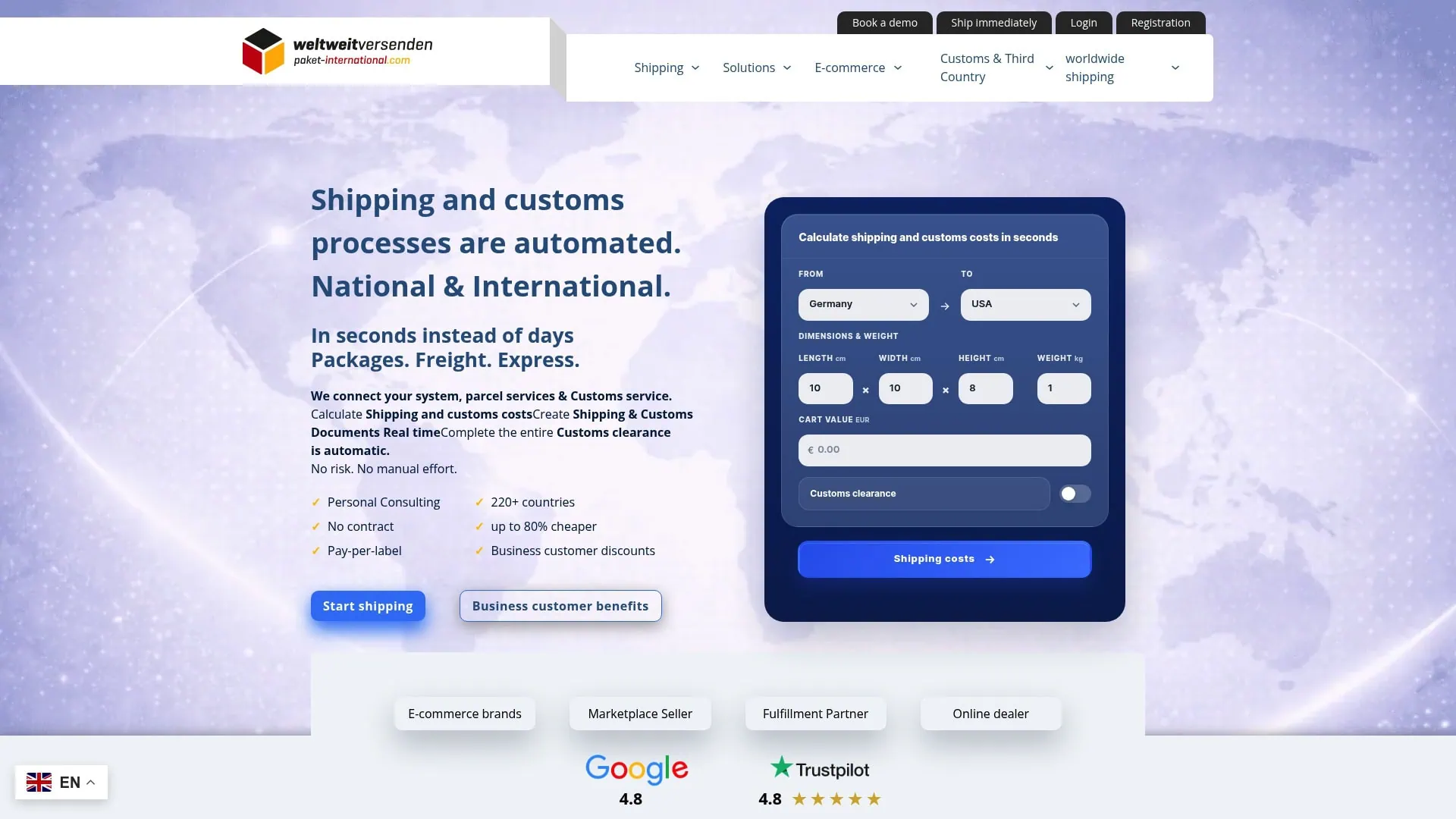
For online retailers and export teams looking to automate their international shipping, Paket-international offers customized price lists, guaranteed landed costs, and proactive support with customs expertise. The platform is GDPR-compliant and based in Germany. Whether it's a standard parcel, pallet, or Bulky goodsThe solution scales with your shipping volume. Request a test integration or demo now and see how quickly the switch pays for itself.