

Maintaining customs master data: A guide for traders and exporters
Customs master data is maintained by recording article, business partner, and process data in a central location, checking it according to fixed rules, clearly assigning responsibility, and updating it whenever there is a change to the customs tariff, supply chain, or authorization. Three things are crucial: a single valid data source, clear responsibilities, and automated checks before data is included in a customs declaration. This guide shows which data is required, how maintenance is organized in practice, and how to avoid typical errors.
In a nutshell
- Customs master data is the basis of every electronic customs declaration. Errors in the master data are repeated in every shipment that accesses it.
- The core information includes commodity code, commodity description, weights, commodity value, origin, EORI numbers of the parties involved, as well as authorizations and deferral accounts.
- Customs authorities analyze registration data as bulk data. This means that inconsistencies are also noticed retrospectively.
- Good care relies on a central data source, the four-eyes principle for tariffs, and regular plausibility checks.
- Automated shipping and customs processes take the data directly from ERP or online shop and reduce manual input to a minimum.
Table of Contents
- What customs master data is and what it is used for
- Which master data is included in every customs declaration
- Why well-maintained master data reduces costs and risks
- Maintaining customs master data in seven steps
- Responsibilities: Who is responsible for the data
- Typical mistakes and how to avoid them
- Practical example: a new item in the online shop
- Continuously monitor data quality
- Master data in the automated shipping process
- Frequently asked questions
- Sources
What customs master data is and what it is used for
Master data is data that rarely changes and is reused in many processes. In customs, this primarily concerns three areas: the goods, the business partners, and the procedures a company uses for importing or exporting goods. Movement data such as shipment number, number of packages, or invoice amount are added for each shipment.
In Germany, customs declarations are generally submitted electronically via the ATLAS IT system, either directly using in-house software or via the interface of a customs service provider. This describes KPMG on the Trade Data Check pageEach of these registrations consists largely of master data. If a product number is incorrectly entered in the item master data, it will be incorrect in every registration that contains that item.
This leads to the core of the task: master data is correctly created once and then actively maintained. Otherwise, a single error will not only have an effect once, but will reappear with every shipment.
Which master data is included in every customs declaration
The The Cologne Chamber of Industry and Commerce (IHK Köln) states in its instructions for import registration The information required before importation includes: EORI number, commodity code, a detailed description of the goods including quantity, weight, and value, delivery and payment terms, the origin of the goods with any applicable preferential certificates, and the contact details of all parties involved. A similar logic applies to exports. The following overview assigns this information to the relevant master data areas.
| Area | Typical fields | Reason for change |
|---|---|---|
| item master | Commodity code, product description, net weight, country of origin, preferential origin, unit of measurement | New products, tariff changes, supplier changes, product modifications |
| Business partner database | Name, address, country code, EORI number, role (importer, exporter, declarant) | New customers, rebranding, relocation, new roles |
| Procedure master | Approvals, deferral accounts, settlement models, procedure codes | New or expiring permits, new delivery routes |
| Conditions | Delivery terms (Incoterms), payment terms, invoice currency | Contract amendments |
Article master data
The item master data is the most error-prone area because it contains the most data records. According to the Cologne Chamber of Industry and Commerce (IHK Köln), the goods details for an import declaration include the eleven-digit commodity code, a precise description of the goods, quantity, raw weight including packaging and net weight without packaging in kilograms, as well as the value of the goods in the invoice currency. For free deliveries, such as samples, the value of the goods must be indicated accordingly.
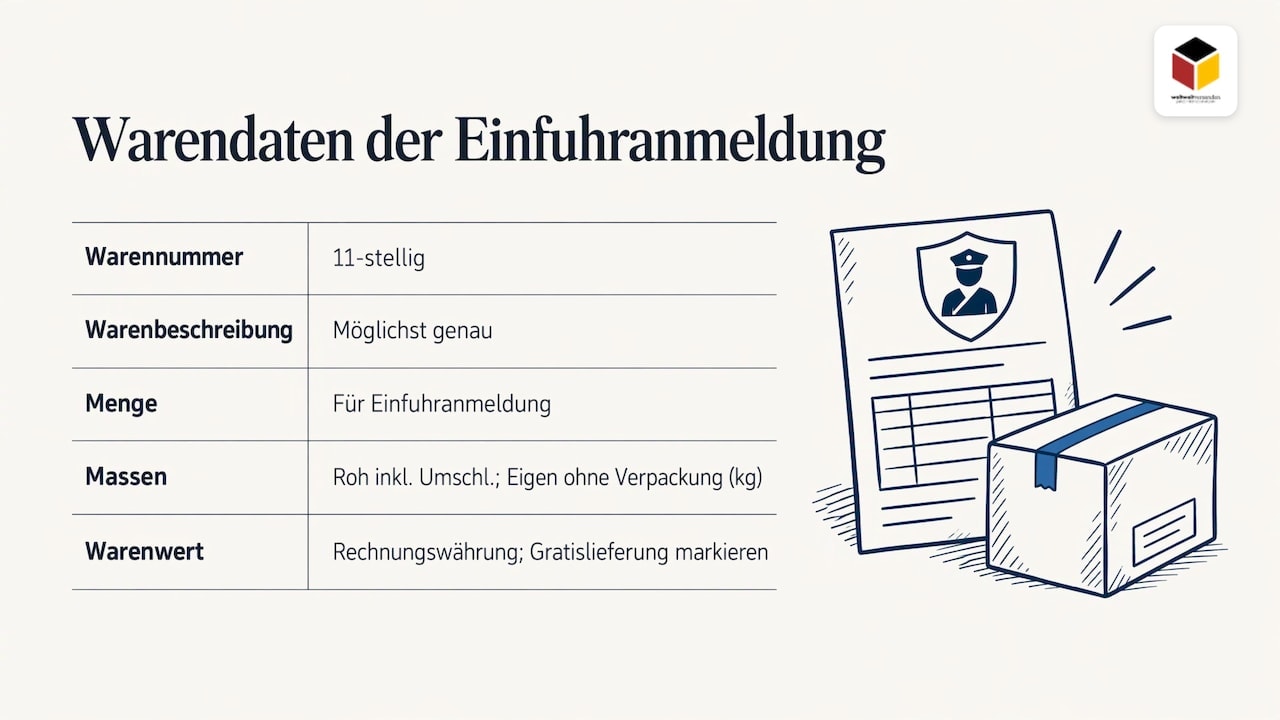
For customs purposes, this means: The net weight is recorded for each item, while the raw weight is usually only determined from the packaging of the shipment. The product description should be suitable for customs clearance. Internal abbreviations or marketing names like "Model X Pro" are insufficient; a description is required that allows for the tariff classification to be understood, such as "Men's knitted cotton T-shirt".
The origin is managed separately from the country of shipment. An item shipped from a German warehouse can have a non-European origin. Those using preferential origin policies must also specify the preferential origin and the basis for it, such as supplier declarations.
Business partner data
For customers and suppliers, clear identification and the correct role are crucial. Complete partner data includes the EORI number, country code, and role in the customs process: importer, exporter, or declarant. A common error occurs when a customer is entered multiple times in the ERP system, once with and once without an EORI number. Which record ends up in the customs declaration is then a matter of chance.
Procedural and approval data
In addition to goods and partners, the master data also includes procedures: permits, deferral accounts, and established processing models for recurring deliveries. Once this information is entered, it doesn't need to be re-entered for each shipment. Permits often have conditions and deadlines. Therefore, they should be included in the master data with their file number and expiration date to ensure that renewals are initiated in a timely manner.
Why well-maintained master data reduces costs and risks
Customs authorities use digital risk management to analyze import and export data, employing mass data analysis. This analysis leads to inspections and audits, and any identified inconsistencies or incorrect customs declarations are systematically investigated. KPMGAnyone who registers the same goods under one commodity code and then under a different commodity code creates exactly these kinds of inconsistencies.
Clean master data has an effect in three directions:
- Compliance: Uniform tariff classification and correct origin information reduce the risk of subsequent investigations and audits.
- Speed: Complete data records prevent queries and rejections. Especially with just-in-time deliveries and in e-commerce, where customers expect short delivery times, every day counts.
- Cost: According to KPMG, those who analyze their registration data in a consolidated manner can identify not only risks, but also potential savings and possible reimbursement claims. Access to analyzable data is a prerequisite.
Maintaining customs master data in seven steps
The following steps have proven effective for companies that regularly ship internationally. They can be applied to an online shop with a few hundred items as well as to a wholesaler with tens of thousands of items.
- Take inventory. First, it is determined where customs data is currently stored: in the ERP system, the shop system, in Excel spreadsheets from the shipping department, or with the service provider. Each source is documented, including the field scope and the responsible party.
- Identify a leading data source. Each data field is maintained by exactly one system. All other systems retrieve the values via interfaces. Parallel maintenance of lists is the most frequent cause of conflicting information.
- Define data standards. Binding rules stipulate how product descriptions are formulated, in which unit weights are given, which fields are mandatory, and how origin information is documented.
- Clean up inventory. Duplicate items are merged, missing EORI numbers are added, and commodity codes are checked randomly or completely. Priority is given to items with high shipping volumes and high customs duties.
- Implement an approval process. New items are only released for export once their commodity code, origin, and net weight have been verified. The four-eyes principle has proven effective for tariff classification: one person performs the classification, and a second person approves the release.
- Systematically implement changes. The customs tariff changes regularly, as do suppliers, products, and permits. For each change, it is determined who notices it and who updates the data. When tariffs change, affected items are specifically filtered and reassessed.
- Check regularly. Random sampling, evaluations of registration data, and internal audits reveal whether the rules are effective. Identified weaknesses are incorporated back into standards and processes.
Responsibilities: Who is responsible for the data
Master data touches multiple departments. Purchasing knows the supplier and therefore the origin, product development knows the material and function, sales knows the customer, and IT operates the systems. Without clear allocation, no one feels responsible.
Researchers from the University of St. Gallen describe in a Organizational concept for data governancethat data quality management within the group must be organized as a cross-departmental task. Also the Fraunhofer IAO Guidelines on Data for Artificial Intelligence It emphasizes clear responsibilities and centralized data management, because isolated data silos hinder data use. The following structure has proven effective for customs master data:
| Rolle | take on |
|---|---|
| Customs department or customs officer | Technical authority: Tariff classification, origin, approvals, release of data sets |
| Procurement | Supplier declarations, origin information, notification of supplier changes |
| Product management | Technical description, material composition, weights |
| Sales and customer service | Customer data, EORI numbers, delivery terms |
| IT and ERP administration | Interfaces, mandatory fields, validation rules, authorizations |
In smaller companies without their own customs department, the shipping or logistics manager often assumes technical responsibility. It is important that this role is officially designated in writing and has a designated deputy.
Typical mistakes and how to avoid them
Most master data problems follow recurring patterns. Those who know these patterns can specifically avoid them.
- Data silos: Product data in the ERP system, customs data in an Excel spreadsheet, shipping data in the online shop. A single, leading data source with interfaces to all other systems provides a solution.
- Manual transmission: Every manual entry is a potential source of error. Automated data transfer between ERP, shop, shipping and customs systems reduces typos and transposed numbers.
- Obsolete commodity codes: After tariff changes, old codes remain in the system. A fixed process for annual and event-driven reviews prevents this.
- Inaccurate product descriptions: Terms like "spare parts", "accessories", or "gift" will lead to follow-up questions. The description should specify the type, material, and intended use.
- Missing dead mass: Registrations cannot be filled out correctly without a net weight per item. This field becomes mandatory when creating an item.
- Confusion of origin and country of dispatch: Both pieces of information are maintained and documented separately.
- Unclear roles among partners: The identity of the importer and the applicant is recorded in the partner database, not in the minds of individual employees.
- Missing versioning: Without a change history, it is impossible to prove during an audit which commodity code was valid at what time. Changes are logged with the date, reason, and person responsible.
Practical example: a new item in the online shop
A retailer adds a stainless steel water bottle to their product range, which they source from a third country and resell to the USA, Great Britain, and Switzerland. To ensure the first international shipment runs smoothly, the item goes through the following stages before being launched on the market:
- Product management records material, capacity and net weight without packaging.
- The purchasing department records the country of origin according to the supplier's documents and notes that there is no preferential origin.
- The person responsible for customs classifies the item, a second person checks and releases it.
- The product description is not "Classic bottle", but "stainless steel drinking bottle, double-walled, 0,75 liters".
- Only then will the item be activated in the shop for countries outside the EU.
Every subsequent shipment accesses this single verified data record. If the supplier changes, this automatically triggers a new origin verification.
Continuously monitor data quality
Once data has been cleaned, it becomes outdated. Therefore, maintenance requires ongoing monitoring. KPMG recommends a proactive plausibility check. within the company, to avoid false declarations and to be prepared for audit orders.
In practice, simple key performance indicators (KPIs) that are evaluated monthly or quarterly have proven effective:
- Completeness rate: Share of active export items with commodity code, origin and net weight.
- Consistency rate: Proportion of articles that were declared in all declarations for a given period with the same commodity code.
- Partner quality: Percentage of business partners outside the EU with valid identification and a clear role.
- Inquiries and rejections: Number of shipments that had to be stopped or corrected due to data errors.
- Processing time: Time from the creation of a new item until its release for export.
Additionally, an annual internal audit is worthwhile. This involves comparing a sample of registrations against invoices, delivery notes, and master data. Discrepancies reveal where the process needs improvement.
In complex tariff classification matters, such as multi-component goods or suspected dual-use goods, consultation with a customs advisor or the responsible customs office is the safest way to proceed before a commodity code is added to the master data.
Master data in the automated shipping process
The biggest advantage lies in avoiding the multiple maintenance of master data and instead using it directly where it originates. When product and customer data from the ERP system or online shop are automatically transferred to shipping labels, commercial invoices, and customs declarations, manual data entry, a potential source of errors, is eliminated.
The Shipping platform of Paket International is designed for this process. It connects ERP and shop systems with parcel services such as DHL, UPS, FedEx, DPD and DB Schenker, as well as with customs services. Shipping costs and customs duties are calculated in seconds, shipping documents are managed centrally, and the automatic customs clearance It runs without manual intervention.
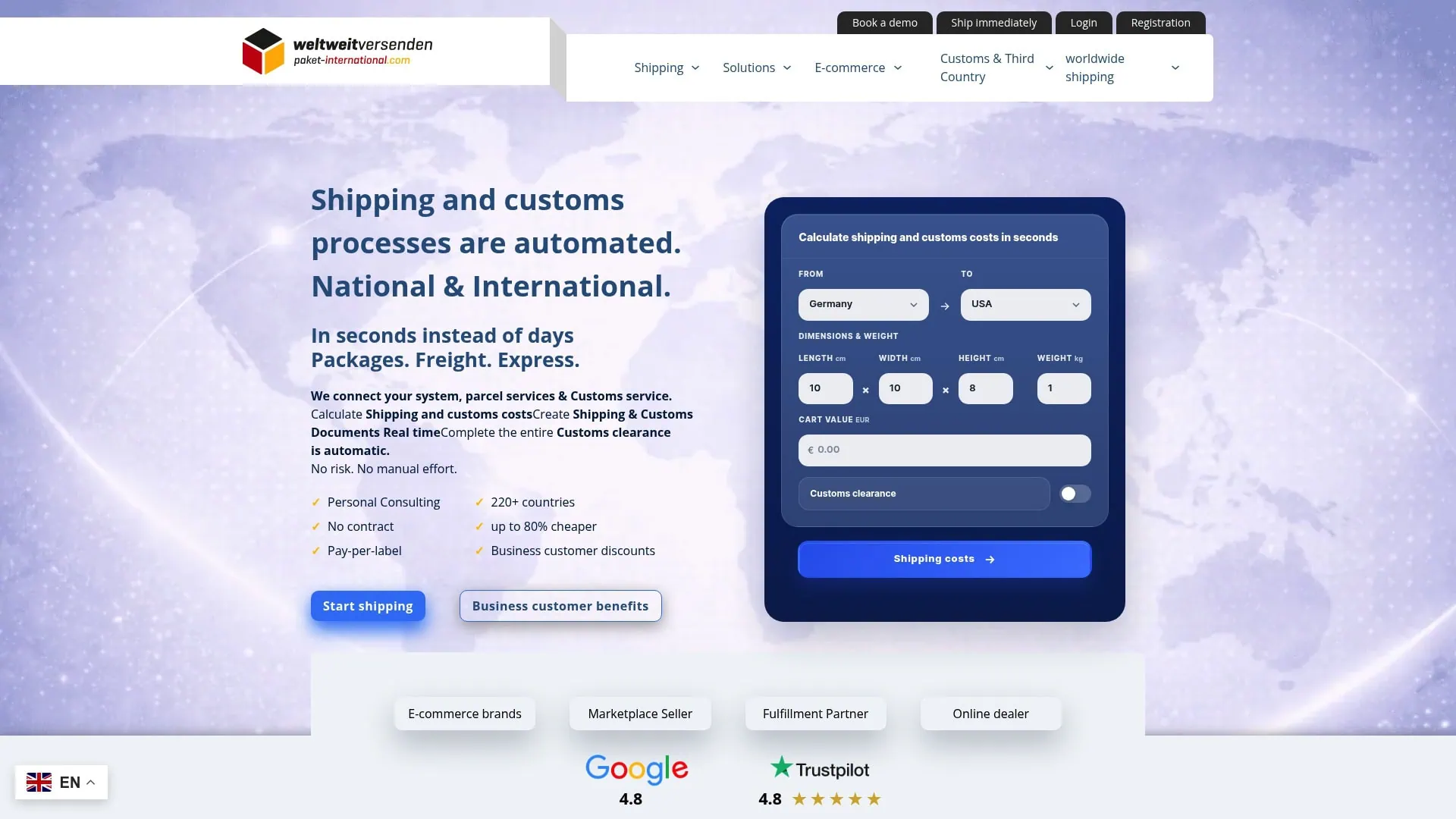
For the connection, a Shipping API and shop integrations Available. All shipments are managed in a central dashboard with real-time tracking. According to the company, this can reduce shipping costs by up to 80%. For individual requirements, Paket International offers customized solutions and proactive communication with customers and customs authorities.
Frequently asked questions
How often should customs master data be checked?
A complete review of active export items is advisable at least once a year, and additionally on an ad-hoc basis in the event of tariff changes, supplier changes, or new authorizations. Key performance indicators (KPIs) regarding completeness and consistency are best evaluated monthly or quarterly. This allows discrepancies to be identified before they are repeated in numerous declarations.
Who is liable for incorrect information in the customs declaration?
The applicant, i.e., the company in whose name the declaration is submitted, is generally responsible, even if a service provider handles the technical transmission. Therefore, the master data sent to a service provider should be reviewed and approved internally. For specific liability questions, a customs consultant or a specialist lawyer in customs law is the appropriate contact.
Is an Excel spreadsheet sufficient for maintaining customs master data?
For a small number of items, a list can be a starting point. However, as the product range grows, mandatory fields, approval processes, change history, and interfaces become essential. System-supported maintenance with automatic data transfer to shipping and customs significantly reduces transmission errors.
What is the minimum data required for international parcel shipping?
For each item, the commodity code, customs-compliant description, net weight, value, and country of origin are required. Complete address details and, where applicable, the EORI number are also needed for both sender and recipient. Delivery terms and the invoice currency complete the information required for the commercial invoice.
Sources
- Cologne Chamber of Industry and Commerce: Import declaration, your guide
- KPMG: Trade Data Check
- University of St. Gallen: Data Governance, organizational concept for group-wide data quality management
- Fraunhofer IAO: Data, the fuel for artificial intelligence